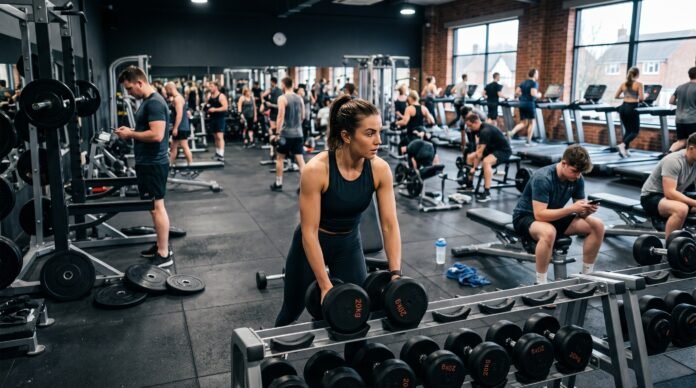


You walk into the gym ready to train. The place is busy, but everything looks manageable. Then you spot it: one person has claimed a bench, three sets of dumbbells and half the cable machine while scrolling through their phone.
Across the room, somebody has left six plates on the leg press. A shaker bottle is leaking beside the squat rack. Another person is filming an entire circuit with a tripod positioned in the middle of the walkway.
None of these offences will appear in a criminal record. But they may make an otherwise friendly gym want to launch you into the car park.
That is why gym etiquette matters.
It is not about memorising a list of fussy traditions or trying to impress the most experienced person in the building. It is simply about training hard without making everybody else’s workout harder. Whether you are entering a gym for the first time or have been lifting for years, these 15 rules will help you avoid becoming that person.
Why Good Gym Etiquette Makes a Difference
A gym is a shared workspace. Everyone is there for a different reason, but they are using the same equipment, changing rooms and training space. One person’s lack of awareness can slow down dozens of other workouts.
Good gym etiquette makes the environment:
- Safer for members and staff
- Easier to navigate during busy periods
- More welcoming for nervous beginners
- Less frustrating for people following structured programmes
- Better for the equipment everyone pays to use
You do not need perfect technique, expensive clothing or an impressive physique to earn respect in a gym. You just need a little awareness.
1. Put Your Weights Back
Let’s start with the obvious one, the rule everybody knows and a surprising number of people ignore.
When you finish with a dumbbell, return it to the rack. When you load a bar or machine, remove the plates afterwards. Do not leave a treasure hunt for the next person, and do not assume someone else wants to begin where your final set ended.
Leaving four plates on each side of a leg press is not proof that you are strong. Putting them away is proof that you understand how a shared space works.
Re-racking also keeps walkways clear and makes the right weights easier to find. If you are strong enough to load it, you are strong enough to unload it.
2. Wipe Down the Equipment
Sweat happens. You are in a gym, not an art gallery. Nobody expects you to finish a hard workout looking freshly showered.
What people do expect is for you to wipe visible sweat from a bench, seat or machine when you finish. Use the cleaning spray, wipes or paper towels supplied by the gym. Pay particular attention to benches, cardio machines and any padded surface you have been leaning against.
You do not need to perform a full forensic clean after every biceps curl. Just leave the equipment in the condition you would hope to find it.
3. Do Not Turn the Bench Into a Phone Booth
Resting between sets is part of training. Taking two or three minutes before another heavy effort can be completely appropriate.
The problem is not using your phone during that rest. The problem is becoming so absorbed in messages, videos or social media that a three-minute rest turns into twelve minutes while somebody waits nearby.
If you are sitting on equipment, keep track of the time. Check your programme, change the song or reply to a quick message, then get ready for the next set. If you need to handle a longer call, step away and free the equipment.
Your bench should support your workout, not your screen time.
4. Let Someone Work In When It Makes Sense
“Working in” means allowing another person to use the same equipment during your rest periods. They complete a set, you adjust the weight if needed, and then you take your next turn.
You do not have to agree every time. It may be impractical if the setup takes several minutes to change, you are using specialist equipment or both people need dramatically different settings. But when the gym is busy and the adjustment is simple, sharing can save everyone time.
A quick “Do you want to work in?” costs nothing. It also makes the gym feel like a community instead of a collection of people defending small pieces of territory.
5. Respect Other People’s Space
Someone preparing for a heavy squat or deadlift does not need a stranger squeezing past the bar at the exact moment they begin. Give people enough room to move safely, especially around free weights, cable stations and lifting platforms.
This also means checking what is happening around you before starting an exercise. A set of walking lunges through the busiest dumbbell area might technically be possible. That does not make it a good decision.
If somebody looks focused and ready to lift, wait a few seconds before crossing their path. Their concentration matters, and so does your safety.
6. Never Interrupt Someone Mid-Set
Need to ask how many sets somebody has left? Fine. Wait until they finish.
Do not approach while they are pressing, squatting, pulling or visibly fighting through a repetition. Even a friendly question can break their focus. At worst, it can cause a failed lift or an injury.
The rule is simple: if their face looks like they are negotiating with gravity, your question can wait.
Make eye contact once the set is over, give them a moment to breathe and then ask politely.
7. Film Responsibly
Recording a set can be useful. It lets you review your technique, track progress or create content. But bringing a camera into a shared gym does not turn everybody else into an unpaid background actor.
If you film your workouts:
- Keep the camera or tripod out of walkways
- Frame the shot to avoid capturing other members where possible
- Do not occupy extra equipment simply to create a better angle
- Ask permission before deliberately including someone
- Follow the gym’s filming policy
- Accept that people may walk through the background of a busy public space
The burden is on the person filming to adapt, not on the entire gym to disappear from the shot.
8. Treat Headphones as a Boundary
Headphones usually communicate a clear message: “I am here to train.”
That does not mean you can never speak to someone wearing them. Asking whether equipment is free, warning them about a safety issue or making a brief practical request is perfectly reasonable. Trying to begin a ten-minute conversation while they repeatedly remove and replace an earbud is less reasonable.
Look for the signals. Short answers, limited eye contact and headphones going straight back in usually mean the conversation is over. Respect that and let them get on with their session.
9. Control Your Weights
Gyms make noise. Heavy deadlifts hit the platform. Weight stacks touch down. People breathe hard when they are working close to their limit. Complete silence is neither realistic nor necessary.
There is still a difference between unavoidable training noise and throwing weights around for attention.
Control dumbbells when you can do so safely. Avoid letting machine stacks crash between every repetition. Use bumper plates and lifting platforms for movements that involve contact with the floor. If a weight is so heavy that every set ends with equipment bouncing into somebody else’s area, reconsider the load or your setup.
Strength gets more impressive when it comes with control.
10. Do Not Block the Mirrors
Mirrors are not only there for progress photos. People use them to monitor their position, check symmetry and make technique adjustments during a set.
If someone is lifting while facing a mirror, avoid stepping directly between them and their reflection. Do not stand inches in front of the dumbbell rack to complete an entire workout either. Select your weights, step back and leave access for everybody else.
And yes, checking your pump is allowed. Just remember that the mirror is shared, even when the lighting is excellent.
11. Keep Bags, Bottles and Tripods Out of the Way
A gym floor is not a storage locker.
Bags, coats, resistance bands, bottles and camera equipment can quickly become trip hazards. Store larger belongings in a locker and keep anything you need during the session close to your station without blocking a walkway.
This matters even more during peak hours, when people are carrying plates and moving around with a limited view of the floor. Your enormous water bottle may be essential to your hydration strategy. It still does not need its own parking space.
12. Ask Before Spotting Someone
A good spotter can give a lifter the confidence to attempt a difficult set safely. An unwanted spotter can distract them, interfere with the repetition or grab the bar before help is needed.
Ask first:
- “Would you like a spot?”
- “How many repetitions are you aiming for?”
- “When do you want me to help?”
If someone asks you to spot them, listen to their instructions. Do not turn their bench press into an upright row from the first repetition. Stay alert, keep your hands ready and assist only when needed.
If there is an immediate safety risk, act accordingly. Otherwise, permission comes first.
13. Keep Unsolicited Advice to Yourself
Most people are not waiting for a stranger to redesign their training programme between sets.
You may have more experience. You may genuinely want to help. You may even be correct. But unless someone asks for feedback or is in immediate danger, unsolicited coaching often feels intrusive rather than useful.
There are many valid ways to perform an exercise. Different people also train around injuries, mobility restrictions and instructions from qualified coaches that you know nothing about.
Being experienced does not make you everybody’s personal trainer. If somebody asks for help, be generous. If they do not, let them train.
14. Practise Basic Hygiene
Nobody expects a gym to smell like a luxury spa. But basic hygiene remains part of being considerate.
Wear reasonably clean training clothes, use deodorant, cover open cuts and wash your hands. Avoid drowning yourself in fragrance; overpowering aftershave can be almost as distracting as body odour in a crowded room.
If you are unwell and likely to spread it, take a rest day or train at home. Missing one workout will not destroy your progress. Passing an illness around the entire gym will not improve anybody else’s.
The standard is not perfection. It is simply arriving in a condition that does not make the people around you regret breathing.
15. Respect Everyone in the Gym
The strongest culture rule is also the simplest: treat people with respect.
Do not mock beginners, stare at other members or comment on somebody else’s body. Be patient with people learning how equipment works. Treat reception staff, coaches and cleaners with the same courtesy you would give your training partner.
Everyone begins somewhere. The confident lifter moving serious weight today once had to learn how to adjust a bench. The nervous newcomer you see this week may still be training consistently ten years from now.
A good facility creates an environment where people of different ages, abilities and goals can make progress. Whether someone is visiting a new facility or joining a local Burton gym, they should be able to train without feeling as though they must first earn the right to belong.
The Quick Gym Etiquette Check
Before you move to your next exercise, ask one question: Am I making this space easier or harder for the next person to use?
| Situation | Good gym etiquette | Poor gym etiquette |
| Equipment is occupied | Ask how many sets remain | Hover, stare or pressure the person |
| The gym is busy | Offer to let someone work in | Claim several stations at once |
| You finish lifting | Re-rack your weights | Leave the equipment loaded |
| You want to film | Use a compact, discreet setup | Block a walkway with a tripod |
| Someone’s technique looks unusual | Leave them alone unless there is immediate danger | Deliver an unsolicited lecture |
Most etiquette problems are not caused by bad people. They are caused by people becoming so absorbed in their own workout that they stop noticing everyone around them. A ten-second reset between exercises fixes a lot: put things back, clean the bench, check the walkway and move on.
Train Hard. Be Considerate. Repeat.
Good gym etiquette does not require complicated rules. Put your weights away. Share when it is practical. Respect people’s space. Clean up after yourself. Avoid turning your workout into an obstacle course for everyone else.
You can train intensely without being inconsiderate. In fact, the people who earn the most respect in a gym are rarely the loudest. They are consistent, focused and aware of the environment around them.
Follow these 15 rules and you will make every session better, not only for yourself, but for the person training beside you.
Now for the honest question: which gym etiquette rule do you wish more people would follow?