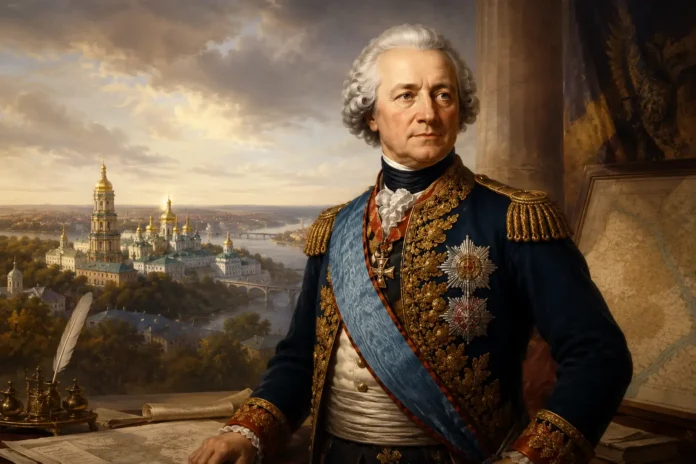


Bernhard Weißbach is most often linked to Johann Bernhard von Weisbach, an 18th-century cavalry general, diplomat, and imperial administrator. He served the Russian Empire during the age of Peter the Great and became connected with major events such as the Battle of Poltava, Russian diplomacy in Vienna, and the governorship of Kyiv.
His name can be confusing because it appears in different spellings. Some records use Bernhard Weißbach. Others use Johann Bernhard von Weisbach, Johann Bernhard Graf Weißbach, Weisbach, or the Russian form Veisbakh. Behind these spellings is a historical figure whose life crossed Central Europe, Russia, Ukraine, and the wider power struggles of early modern Europe.
Quick Bio: Bernhard Weißbach
| Field | Details |
| Full Name | Johann Bernhard von Weisbach |
| Common Search Name | Bernhard Weißbach |
| Other Name Forms | Weisbach, Weissbach, Graf Weißbach, Veisbakh |
| Born | 1665 |
| Birth Region | Sources differ between the Bohemian and the Silesian/Central European background |
| Died | 1735 |
| Place of Death | Poltava |
| Profession | Cavalry general, diplomat, administrator |
| Military Rank | General of Cavalry; General-in-Chief |
| Known For | Battle of Poltava, Vienna diplomatic mission, Kyiv governorship |
| Served | Russian Empire |
| Linked To | Peter the Great, Great Northern War, Kyiv, Poltava |
| Kyiv Role | Governor-General of Kyiv, 1731–1735 |
| Awards | Order of St. Alexander Nevsky, Order of St. Andrew |
Who Was Bernhard Weißbach?
Bernhard Weißbach was not a modern celebrity, actor, influencer, or media personality. The name is important because it points to Johann Bernhard von Weisbach, a military and diplomatic figure from the early 18th century.
He belonged to a world where talented officers often moved between empires. A man could begin his career in one army, enter service under another ruler, and later become a diplomat or regional governor. Weisbach’s life followed that pattern. He began in the Central European imperial military world and later entered Russian service during a time when Peter the Great was building a stronger, more European-style military state.
What makes Weisbach interesting is not fame in the modern sense. It is the range of his career. He was connected with battlefield command, diplomatic work, and frontier administration. Few figures from his time moved through all three roles so clearly.
Is Bernhard Weißbach the same as Johann Bernhard von Weisbach?
In most historical search contexts, yes. Bernhard Weißbach usually refers to Johann Bernhard von Weisbach, also written as Johann Bernhard Graf Weißbach.
The spelling changes because the name passed through several languages and writing systems. In German, the letter “ß” can become “ss,” so Weißbach may appear as Weissbach. In English, the name is often simplified as Weisbach. In Russian sources, it appears as Veisbakh or Вейсбах.
This is one reason people searching for the name may find mixed results. Some pages treat Bernhard Weißbach as a surname or genealogy topic. Others connect it to military history. The strongest historical identity behind the keyword is Johann Bernhard von Weisbach, the general and diplomat who served Russia in the age of Peter the Great.
Why the Name Bernhard Weißbach Causes Confusion
The name confuses for three main reasons.
First, Weißbach is a German-style surname. It can refer to different people, families, places, and records. A searcher looking for family history may not be looking for the Russian general at all.
Second, the name appears in different forms. “Weißbach,” “Weissbach,” “Weisbach,” and “Veisbakh” may all point to the same historical figure in different sources.
Third, Bernhard Weißbach was not a modern public figure. He did not leave interviews, social media profiles, photos, or personal statements. His story comes from military dictionaries, diplomatic records, historical biographies, and regional histories. That makes his identity harder for casual readers to understand quickly.
A good way to read the name is this: if the context mentions Peter the Great, Poltava, Vienna, Kyiv, or the Russian Empire, it is almost certainly about Johann Bernhard von Weisbach.
Early Life and Central European Background
Johann Bernhard von Weisbach was born in 1665. His exact regional identity is described differently across sources. Some records identify him as a native of Bohemia. Other scholarship describes him as Silesian and Catholic, with earlier links to Imperial service.
This difference is not unusual for a man from Central Europe in the 17th and 18th centuries. Borders, loyalties, languages, and ruling powers were often layered and complex. A person could be born in one crown land, serve under another power, and be described by later writers through religion, language, region, or military affiliation.
What is clear is that Weisbach came from the Central European military world before entering Russian service. He was not an outsider with no training. He arrived with enough experience to be trusted with cavalry command, and his later career shows that Peter the Great valued him highly.
Entering Russian Service in 1707
Weisbach entered Russian service in 1707, during the Great Northern War. This was a major conflict between Russia and Sweden, with several other European powers drawn into the struggle. Peter the Great needed skilled officers who understood modern warfare, cavalry discipline, fortifications, and European military practice.
Weisbach joined as a colonel and received command of a dragoon regiment. His transfer was connected with the wider recruitment of foreign officers into Russian service. Peter the Great wanted to modernize Russia’s army, and experienced men from Central Europe were useful in that effort.
One early moment helped build Weisbach’s reputation. At Tykocin, he reportedly withdrew a Russian garrison without losses and destroyed the fortifications despite the danger of nearby Swedish forces. This action brought him to Peter’s attention and helped him rise in rank.
Military Career Before Poltava
Before the famous Battle of Poltava, Weisbach was already active in several campaigns. In 1708, he took part in fighting near Holowczyn and distinguished himself near Smolyany. These events came during a difficult period of the Great Northern War, when Charles XII of Sweden was pushing deep into the lands around Russia and Ukraine.
Weisbach’s role was not that of a ceremonial officer. He served in real field conditions, often in fast-moving cavalry operations. Cavalry mattered greatly in this period because armies needed mobility, scouting, pursuit, and protection against raids. A commander who could handle cavalry well was valuable.
In early 1709, Weisbach also fought near Rashevka, where a Swedish detachment was forced to surrender. This added to his standing before the decisive battle that would soon change the balance of power in Eastern Europe.
Bernhard Weißbach at the Battle of Poltava
The Battle of Poltava took place in 1709 and became one of the most important battles of the Great Northern War. Russia, led by Peter the Great, defeated the Swedish army of Charles XII. The result weakened Sweden’s position as a major power and helped confirm Russia’s rise in Eastern Europe.
Weisbach’s role at Poltava was important because he was connected with cavalry command. Historical entries identify him as commanding cavalry on the Russian right wing during the battle. He was wounded but did not leave the field. After the Swedish defeat, he joined the pursuit of the remaining Swedish forces toward Perevolochna.
This detail matters because many short online biographies only say he was “connected to Poltava.” A stronger biography should explain what that connection means. Weisbach was not just alive during the battle. He was part of the Russian command structure during one of the most decisive military moments of Peter the Great’s reign.
After Poltava, Peter promoted him to the rank of major general. This shows that his service was not forgotten. In the Russian imperial system, battlefield trust often opened the way to later diplomatic and administrative posts.
The Pruth Campaign and Defense of Ukraine
In 1711, Weisbach took part in the Pruth campaign against the Ottoman Empire. The campaign was difficult for Russia and ended in an unfavorable situation for Peter the Great. Even so, officers like Weisbach remained important because the southern frontier still needed defense.
After the campaign, Weisbach was connected with the defense of Ukraine against Crimean Tatar raids. In 1713, he is credited with defeating Crimean Tatar forces near Bohodukhiv. This part of his career is important because it shows the shift from major European battlefields to frontier defense.
The Russian Empire’s southern and Ukrainian borderlands were not quiet administrative regions. They were zones of military pressure, political negotiation, Cossack power, Ottoman influence, and local resistance. A commander in this region had to understand both warfare and administration.
Diplomatic Mission to Vienna
Weisbach was later sent on a diplomatic mission to Vienna. This move may seem surprising today, but in Peter the Great’s Russia, it made sense. Senior officers were often trusted with diplomatic tasks because they had already proved loyalty, discipline, and judgment.
Vienna was one of the most important diplomatic centers in Europe. It was the seat of Habsburg power and a key place for negotiations involving the Holy Roman Empire, Russia, Sweden, Poland, religion, and balance-of-power politics.
Weisbach’s mission placed him in sensitive conversations connected with Russian interests after years of war. His background made him useful there. He understood Central European military and political culture, and he was Catholic, which mattered in certain Habsburg court discussions.
This part of his life separates him from many ordinary generals. He was not only a battlefield officer. Peter used him as a political tool in a complex European setting.
Return to Military and Administrative Service
After his Vienna mission, Weisbach continued to serve in important posts. He was connected with command in Little Russia, also known historically as the Hetmanate region. He later became a member of the Military College, one of the central institutions of Russian military administration.
In 1725, he was promoted to General of Cavalry. This was a high rank and reflected his long service. By this time, Weisbach was no longer simply a foreign officer in a Russian uniform. He had become part of the empire’s senior military and administrative elite.
His career also continued under later rulers after Peter the Great. This matters because many foreign officers rose under Peter but faded after his death. Weisbach remained useful through changing political conditions.
Count Title and Imperial Honors
Weisbach received high honors during his later career. He was raised to the rank of count by Emperor Charles VI. He also received the Russian Order of St. Alexander Nevsky in 1730 and the Order of St. Andrew in 1733.
These honors show that his status crossed imperial boundaries. He had recognition in both the Habsburg and Russian worlds. That fits the pattern of his life: Central European by origin, Russian by service, military by training, diplomatic by assignment, and administrative by final office.
For readers, this is one of the most interesting parts of his story. Weisbach was not tied to one simple national identity. He belonged to the mobile elite of early modern Europe, where rank and service often mattered more than modern ideas of nationality.
Governor-General of Kyiv, 1731–1735
In 1731, Weisbach was appointed Governor-General of Kyiv. He held this post until 1735.
Kyiv was not an ordinary provincial office. It was a city with deep religious, cultural, and political meaning. It also sat in a region that mattered greatly to Russian imperial security. The governor-general had to deal with military defense, local administration, imperial policy, and the wider politics of Ukraine and the southern frontier.
Weisbach’s appointment shows how much trust the empire placed in him. The position required more than paperwork. It required military experience, political judgment, and the ability to represent imperial power far from the center.
During this period, he was also linked with defense planning and the Ukrainian Line, a system of fortifications built to protect the southern frontier. This work connected his final years to the same problem that had shaped much of his career: how to defend and control the borderlands between Russia, Ukraine, the steppe, and Ottoman-linked powers.
Final Years and Death in Poltava
In 1735, Weisbach was ordered to prepare a campaign against Tatar forces in Crimea. Before he could complete that campaign, he died in Poltava.
His death in Poltava has symbolic weight. Poltava was the place where his name had become tied to one of the great victories of Peter the Great’s era. Decades later, he died in the same city while preparing for another military operation on the southern frontier.
He was buried in Poltava. His career ended not in retirement, but while still connected with active imperial service.
Common Name Variants
| Year | Event |
| 1665 | Born in Central Europe, with sources identifying Bohemia or Silesian background |
| 1707 | Entered Russian service as a colonel |
| 1708 | Took part in campaigns near Holowczyn and Smolyany |
| 1709 | Fought at Rashevka and later commanded cavalry at Poltava |
| 1709 | Promoted after the Battle of Poltava |
| 1711 | Took part in the Pruth campaign |
| 1713 | Defeated Crimean Tatar forces near Bohodukhiv |
| 1715–1717 | Served in operations connected with Poland |
| 1718 | Appointed to command cavalry forces in Ukraine |
| 1719 | Sent on a diplomatic mission to Vienna |
| 1720 | Returned to command duties in Little Russia |
| 1723 | Became a member of the Military College |
| 1725 | Promoted to General of Cavalry |
| 1730 | Awarded the Order of St. Alexander Nevsky |
| 1731 | Appointed Governor-General of Kyiv |
| 1733 | Awarded the Order of St. Andrew |
| 1735 | Died in Poltava while preparing for a Crimea campaign |
Why Bernhard Weißbach Still Gets Search Interest
People search for Bernhard Weißbach for several reasons. Some want to know whether he was a celebrity. He was not. He was a historical military and diplomatic figure.
Some find the name through genealogy research. This makes sense because Weißbach is a surname with German-language roots and several possible family branches.
Others discover the name through the Battle of Poltava, Peter the Great, Kyiv history, or Russian imperial biographies. In that context, the most important figure is Johann Bernhard von Weisbach.
The problem is that the internet does not always separate these search intents clearly. A person looking for the general may find surname pages. A person looking for genealogy may find military history. A good article needs to explain both, then guide readers to the strongest verified identity.
Was Bernhard Weißbach a Celebrity?
No. Bernhard Weißbach was not a celebrity in the modern sense.
He had no entertainment career, public interviews, brand image, social media following, or modern fame. His public profile comes from military service, state records, diplomatic work, and historical reference books.
Still, his life can interest readers who enjoy public-figure biographies. He had rank, status, political access, and a career tied to major events. That makes him a serious historical personality, even if he does not belong to modern celebrity culture.
What Made Weisbach Important?
Weisbach was important because he stood at the meeting point of war, diplomacy, and imperial rule.
At Poltava, he served in a battle that helped change the future of Eastern Europe. In Vienna, he represented Russian interests in one of Europe’s most powerful courts. In Kyiv, he helped govern a region that was central to Russian strategy and Ukrainian history.
His career also shows how Peter the Great built power. Peter did not rely only on old Russian noble families. He brought in foreign officers, tested them in battle, and used the best of them in military, diplomatic, and administrative roles.
Weisbach’s life is a strong example of that system.
Common Name Variants
| Name Variant | Where It Appears |
| Bernhard Weißbach | German-style and SEO search form |
| Bernhard Weissbach | English typing without “ß” |
| Johann Bernhard von Weisbach | Common English historical form |
| Johann Bernhard Graf Weißbach | German form with a count title |
| Weisbach | Simplified surname form |
| Veisbakh | Russian transliteration |
| Вейсбах | Cyrillic spelling |
Conclusion
Bernhard Weißbach is best understood as Johann Bernhard von Weisbach, a Central European officer who became one of the notable foreign-born figures in Russian imperial service. His career moved from cavalry command to diplomacy and then to high-level governance in Kyiv.
He fought in the age of Peter the Great, became linked with the Battle of Poltava, represented Russian interests in Vienna, and later governed one of the empire’s most sensitive frontier regions. His name may appear in several forms, but the historical figure behind it is clear: a general, diplomat, and administrator whose life reflected the hard, shifting politics of early 18th-century Europe.
Read More Interesting: Ben Garfield: Doctor, Researcher, Andrew’s Brother
Who was Bernhard Weißbach?
Bernhard Weißbach is most commonly linked to Johann Bernhard von Weisbach, an 18th-century cavalry general, diplomat, and Kyiv Governor-General who served the Russian Empire.
What is Bernhard Weißbach known for?
He is known for his role in Russian military service, his connection to the Battle of Poltava, his diplomatic mission to Vienna, and his service as Governor-General of Kyiv from 1731 to 1735.
Was Bernhard Weißbach a real historical person?
Yes. The historical figure behind the name is Johann Bernhard von Weisbach, also written as Johann Bernhard Graf Weißbach or Veisbakh in different sources.
Was Bernhard Weißbach a celebrity?
No. He was not a modern celebrity. His importance comes from historical military, diplomatic, and administrative roles.
Is Bernhard Weißbach connected to Peter the Great?
Yes. Weisbach served the Russian Empire during the time of Peter the Great and rose within the military and diplomatic system Peter built.
What did Bernhard Weißbach do at the Battle of Poltava?
Historical records connect him with command of Russian cavalry on the right wing during the Battle of Poltava. He was wounded but remained active and later joined the pursuit of Swedish forces.
When was Bernhard Weißbach the Governor-General of Kyiv?
He served as Governor-General of Kyiv from 1731 to 1735.
Where was Bernhard Weißbach born?
Sources differ. Some identify him as born in Bohemia, while other scholars describe him as Silesian and Catholic. Both descriptions place him within the Central European imperial world.
When did Bernhard Weißbach die?
He died in 1735 in Poltava while preparing for a campaign toward Crimea.
Why are there different spellings of his name?
The name moved across German, English, and Russian sources. Weißbach may become Weissbach in English typing, Weisbach in simplified form, and Veisbakh in Russian transliteration.