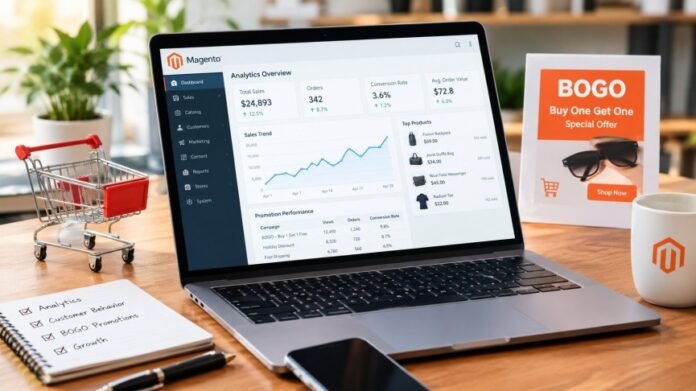


Successful eCommerce businesses need more than quality products and competitive prices. They must understand customer behavior, create convenient shopping experiences, and offer promotions that encourage customers to complete purchases. Magento provides a flexible platform for managing these activities, but achieving consistent results requires careful planning and reliable tools.
Merchants face two common challenges: understanding which activities drive sales and designing offers that attract customers without damaging profit margins. Analytics helps businesses evaluate performance, while targeted promotions can encourage shoppers to explore products and increase order values.
Amasty, a specialist in Magento extensions and eCommerce solutions, helps merchants address practical challenges across their online stores. By combining accurate measurement with thoughtful promotional strategies, businesses can make better decisions, improve customer engagement, and build a more sustainable approach to eCommerce growth.
1. Using Analytics to Understand Customer Behavior
Every visit to an online store provides an opportunity to learn about customer preferences. Merchants can examine product views, cart additions, checkout activity, and completed purchases to understand how shoppers interact with their websites. Without reliable measurement, however, it becomes difficult to distinguish effective strategies from activities that generate little value.
A well-planned magento analytics integration can help businesses connect store activity with tools such as Google Analytics 4 through Google Tag Manager. Amasty offers a Magento extension designed to support tracking integration and eCommerce event measurement.
Before implementation, merchants should define the information they need. Useful measurements may include product engagement, conversion rates, transaction values, and checkout abandonment. Developers should then test event collection to identify missing data, duplicate transactions, or incorrect product information.
Privacy and consent requirements also deserve attention. Tracking should be configured responsibly and in line with applicable rules. With accurate data and clear objectives, merchants can identify opportunities for improvement and evaluate whether changes deliver meaningful business results.
2. Creating Effective BOGO Promotions
Promotions can encourage customers to purchase when an offer provides clear and relevant value. Buy-one-get-one deals, commonly known as BOGO promotions, are one option for increasing product engagement, moving selected inventory, or introducing customers to complementary items.
A magento bogo strategy can be implemented through promotional functionality that supports free gifts or qualifying purchase conditions. Amasty’s Free Gift extension provides merchants with options for offering gifts based on configured shopping rules, helping businesses create targeted incentives within their Magento stores.
The offer should match the business objective. A free complementary product may encourage customers to try an unfamiliar category, while a qualifying-purchase promotion may motivate shoppers to add another item to their cart. Clear terms are essential so customers understand which products qualify and what they need to do.
Merchants should also calculate the financial impact before launching a campaign. Product costs, fulfillment expenses, discount values, and expected order volume all affect profitability. A promotion that increases sales but significantly reduces margins may not deliver sustainable value. Careful planning helps ensure that BOGO offers support both customer satisfaction and business goals.
3. Measuring Promotional Performance
Launching a promotion is only the beginning. Merchants need to determine whether an offer attracts new customers, increases average order value, improves product movement, or simply shifts purchases that would have happened anyway.
Analytics can help answer these questions by comparing performance before, during, and after a campaign. Relevant measures include conversion rate, units sold, revenue per order, promotion redemption, and gross margin. Businesses should also monitor whether customers return after using an incentive.
Segmenting results can provide additional insight. For example, a free-gift offer may perform differently for first-time buyers than for returning customers. Product category, traffic source, and device type may also influence results.
Comparisons should account for other factors that affect sales, such as seasonal demand, advertising changes, and inventory availability. Where practical, merchants can test different offers with comparable audiences to understand which approach performs better.
The purpose of measurement is not simply to identify the promotion with the highest sales volume. It is to understand which campaigns create worthwhile business outcomes. Consistent evaluation allows merchants to refine their promotional strategies using evidence rather than assumptions.
4. Building a Maintainable Magento Promotion Strategy
Promotional rules and analytics integrations must operate reliably within the wider Magento environment. Stores may use multiple extensions for pricing, checkout, inventory, customer accounts, and marketing. Poorly coordinated configurations can create unexpected discounts, inaccurate reports, or confusing customer experiences.
Before introducing a new promotion, merchants should define eligibility rules, qualifying products, campaign dates, and any restrictions. They should test how offers behave when customers apply coupons, remove items, change quantities, or combine eligible products with other discounts.
Extension compatibility is equally important. Businesses should review documentation, supported Magento versions, update history, and vendor support before installing new functionality. Testing in a staging environment helps uncover conflicts before changes reach the live storefront.
Amasty’s Magento-focused expertise and extension ecosystem give merchants options for addressing analytics and promotional requirements. However, reliable results still depend on appropriate configuration, regular maintenance, and clear operational processes.
Teams should document important settings and review campaign results after each launch. This makes it easier to identify problems, repeat successful approaches, and retire promotions that no longer serve a useful purpose.
Conclusion
Analytics and promotional planning serve different purposes, but they become more effective when used together. Accurate tracking helps Magento merchants understand customer behavior, while carefully designed BOGO offers give shoppers a practical reason to consider additional products or complete a purchase.
Amasty’s specialized Magento extensions provide options for supporting these activities, from analytics integration to free-gift promotions. Businesses should select tools according to their actual needs, verify compatibility, and test implementations before relying on them in a live store.
Long-term success depends on more than launching attractive offers or collecting large amounts of data. Merchants need clear objectives, reliable measurement, transparent promotional terms, and regular reviews of profitability and customer response. By connecting these practices, businesses can make better-informed decisions and improve the consistency of their eCommerce operations. A disciplined, customer-focused approach helps Magento stores adapt to changing expectations while supporting sustainable growth.