

Introduction
Healthcare robotics is transforming how hospitals deliver care, improve efficiency, and support medical professionals. From surgical robots to patient monitoring systems, automation is helping healthcare providers handle complex tasks with greater precision.
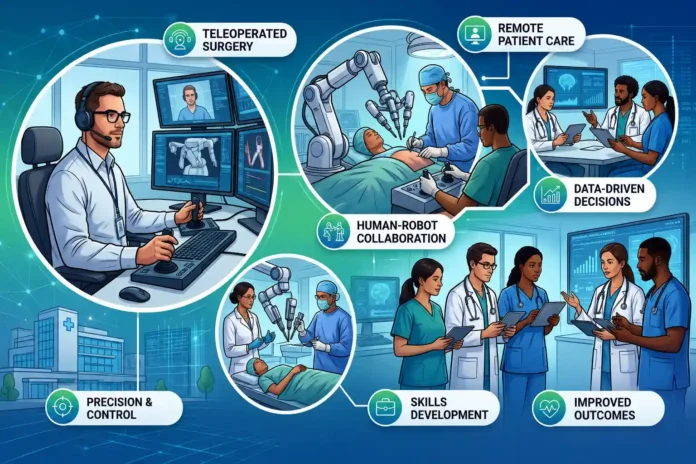
However, despite these advancements, automation alone is not enough. Real-world healthcare environments are unpredictable, requiring human judgment, quick decision-making, and continuous oversight. This is where remote operators in healthcare robotics play a critical role.
In this article, we explore how remote operators go beyond automation and why they are essential in modern healthcare systems.
The Rise of Healthcare Robotics and Automation
Healthcare facilities are increasingly adopting robotics for:
- Surgical assistance
- Patient monitoring
- Disinfection and sanitation
- Medication delivery
These systems rely on artificial intelligence (AI) and automation to improve accuracy and reduce manual workload. However, fully autonomous systems still face limitations, especially in sensitive medical environments.
Why Automation Alone Is Not Enough
Even advanced healthcare robots can encounter challenges such as:
- Unexpected patient conditions
- Complex hospital layouts
- Sensor limitations or system errors
- Critical decision-making scenarios
These limitations highlight the need for human oversight in healthcare robotics to ensure safety and reliability.
1. Real-Time Support in Critical Medical Situations
Remote operators provide immediate support when robotic systems require human intervention.
They help:
- Guide robotic actions during unexpected situations
- Assist in real-time decision-making
- Ensure patient safety during critical procedures
This human involvement is essential in high-risk environments like operating rooms and intensive care units.
2. Enhancing Patient Safety and Care Quality
Patient safety is the top priority in healthcare.
Remote operators improve safety by:
Monitoring robotic performance continuously- Identifying potential risks early
- Responding quickly to system alerts
This ensures that robotic systems function accurately and safely at all times.
3. Supporting Complex Healthcare Environments
Hospitals are dynamic environments with constant movement and changing conditions.
Remote operators assist by:
- Navigating robots through busy hospital settings
- Managing interactions with patients and staff
- Adapting to real-time environmental changes
This improves operational efficiency while maintaining safety standards.
4. Reducing Downtime and Improving System Reliability
Technical issues in healthcare robotics can disrupt critical services.
Remote operators help:
- Detect issues early
- Troubleshoot system errors
- Maintain continuous operation
This reduces downtime and ensures that healthcare services remain uninterrupted.
5. Enabling Scalable Healthcare Robotics Solutions
As healthcare organizations expand, their use of robotics increases.
Remote operation allows:
- Centralized monitoring of multiple systems
- Scalable support across facilities
- Efficient resource management
This makes it easier for hospitals to adopt robotics without increasing internal workload.
The Role of Remote Monitoring and Teleoperation Services
To maintain efficiency and safety, many healthcare providers rely on solutions like Robot Teleoperation & Robot Monitoring Service. These services provide:
- Skilled remote operators
- 24/7 system monitoring
- Real-time intervention and support
By combining automation with human expertise, healthcare organizations can ensure that their robotic systems operate at the highest level of performance.
The Future of Healthcare Robotics
The future of healthcare robotics lies in a hybrid model, where:
- Automation handles repetitive tasks
- Human operators make complex and critical decisions
This approach ensures:
- Better patient outcomes
- Improved operational efficiency
- Safer healthcare environments
As technology evolves, the role of remote operators will continue to grow.
Conclusion
Healthcare robotics is advancing rapidly, but human oversight remains essential. Remote operators play a key role in ensuring safety, improving system reliability, and supporting complex medical environments.
By going beyond automation, healthcare organizations can deliver better patient care while maximizing the benefits of robotic systems. In today’s healthcare landscape, combining automation with human expertise is the key to long-term success.