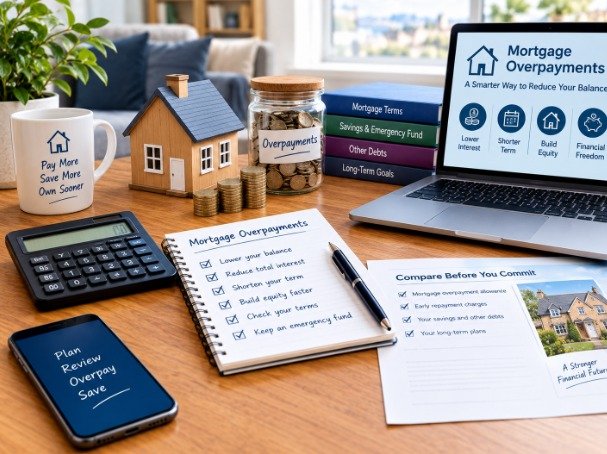


For many homeowners, paying more than the required mortgage payment can be an appealing way to reduce their outstanding balance.
Mortgage overpayments can potentially shorten the mortgage term and reduce the total interest paid over the life of the loan. They can also help homeowners build equity more quickly.
However, paying extra into a mortgage is not automatically the right financial decision for everyone.
Mortgage products can have annual overpayment limits, early repayment charges and specific rules about how additional payments are applied. Homeowners also need to consider emergency savings, other debts and their wider financial plans.
Understanding the rules before making an overpayment is therefore important.
What Is a Mortgage Overpayment?
A mortgage overpayment is any payment made toward your mortgage above the scheduled amount.
Depending on the mortgage product, this could involve:
- Paying a little extra every month
- Increasing the regular mortgage payment
- Making a one-off lump-sum payment
- Using a bonus or other windfall to reduce the mortgage balance
When an overpayment reduces the outstanding mortgage balance, future mortgage interest may be calculated on a smaller amount.
The precise effect depends on the mortgage type, interest calculation and lender’s terms.
Some mortgages allow borrowers to overpay a certain percentage of the outstanding balance each year without an early repayment charge.
Others may have different arrangements.
Before making an additional payment, check your specific mortgage conditions rather than assuming that the rules are the same for every lender.
Why Do Homeowners Overpay Their Mortgage?
The most obvious reason is to reduce the mortgage balance faster.
Suppose a homeowner has a mortgage with several years remaining. By making regular additional payments, they may be able to reduce the outstanding capital more quickly.
This can potentially reduce the amount of interest paid over the full mortgage term.
Overpayments may also shorten the time before the homeowner becomes mortgage-free.
For some homeowners, this is an important long-term financial goal.
There can also be a psychological benefit. Seeing the mortgage balance decline faster can give homeowners a greater sense of progress.
However, mortgage overpayments need to be considered alongside liquidity.
Money paid into a property is generally less accessible than money held in a savings account.
If an emergency occurs later, the homeowner may not be able to withdraw the overpayment from the mortgage.
Check Your Mortgage Overpayment Allowance
One of the most important steps before making an overpayment is checking your mortgage terms.
Many mortgage products allow a certain percentage of the outstanding balance to be repaid each year without an early repayment charge.
For example, a product may allow overpayments of a particular percentage annually.
However, the precise allowance, calculation method and relevant dates vary between mortgages.
Some lenders may calculate the allowance based on the original balance, while others may use another method.
There can also be rules about when the annual allowance resets.
If you exceed the permitted amount while an early repayment charge applies, the additional cost could reduce the financial benefit of making the payment.
For that reason, homeowners should check the mortgage conditions before making a significant lump-sum payment.
Consider Your Emergency Savings
One of the biggest questions to consider is whether you have enough accessible savings.
Homeowners can face unexpected costs at any time.
A boiler could fail. A car may require expensive repairs. A period of unemployment or reduced income could affect household cash flow.
If all available savings are used to pay down the mortgage, you may have to rely on credit if an emergency occurs.
That could create a new financial problem.
For this reason, it can be sensible to maintain an appropriate emergency reserve before committing substantial savings to mortgage overpayments.
The amount required will depend on your income, employment security, household commitments and expected expenses.
The important point is that a mortgage overpayment should form part of a wider financial plan.
Compare the Mortgage With Other Debts
Homeowners should also consider other borrowing.
If you have an expensive credit-card balance or personal loan, the interest rate on that debt may be considerably higher than your mortgage rate.
In some circumstances, paying down higher-cost debt may be a priority.
However, individual circumstances vary.
Some credit-card balances may have promotional rates, while other debts may have early repayment conditions.
The correct approach is to look at the whole household balance sheet rather than focusing exclusively on the mortgage.
If debt repayments are already difficult to manage, independent debt advice may be more appropriate than simply making mortgage overpayments.
Compare Savings With Mortgage Interest
Another consideration is what your money could earn if it remained in savings.
Suppose you have £10,000 available and are deciding whether to use it for a mortgage overpayment or keep it in an accessible savings account.
You can compare the mortgage interest rate with the return available on savings, taking applicable tax considerations into account.
However, this is not purely a mathematical decision.
Savings provide liquidity.
Mortgage overpayments reduce debt.
The best choice may therefore depend on both the financial return and how important access to the money is.
Homeowners should consider their wider financial position before committing their savings to the property.
Think About the Mortgage Term
The effect of an overpayment can depend on how your lender applies it.
Some lenders may allow the borrower to reduce the mortgage term while maintaining the existing monthly payment.
Other arrangements may result in a recalculation of the monthly payment.
If your objective is to become mortgage-free sooner, make sure you understand exactly how the lender will treat the additional payment.
A reduced monthly payment is not necessarily the same as a shorter mortgage term.
If you want to maintain your existing monthly payment after making an overpayment, ask the lender whether this is possible and how the payment will affect the remaining term.
Use Windfalls Carefully
A bonus, inheritance, investment maturity or other windfall can provide an opportunity to make a large mortgage payment.
Before doing so, consider whether the money has another purpose.
You might need to replace your car, renovate the property, fund education costs or maintain a larger emergency reserve.
There is no requirement to use every available lump sum to repay the mortgage.
If you decide that an overpayment is appropriate, check the mortgage allowance first.
Keep documentation confirming the payment and make sure it has been correctly applied to the mortgage balance.
Consider the Effect on Your Loan-to-Value Ratio
Reducing the mortgage balance can increase your equity in the property.
This can improve your loan-to-value position.
For example, if your property is worth £300,000 and your mortgage balance falls from £210,000 to £180,000, the loan-to-value ratio has changed significantly.
A lower loan-to-value ratio can sometimes provide access to different mortgage products when you next remortgage.
However, this should not be treated as a guarantee.
Future mortgage rates depend on lender criteria, market conditions, property valuation, income and other factors.
Property values can also rise or fall.
The primary reason for an overpayment should therefore be based on your own financial objectives rather than an assumption about a future mortgage rate.
Think About Your Future Plans
Your plans for the property can also influence whether overpayments make sense.
If you expect to move within a few years, consider how the overpayment interacts with your future purchase.
If you are planning a major renovation, keeping cash available may be more useful.
If you expect to remain in the property for decades and want to reduce long-term debt, regular overpayments may be more attractive.
There is no single strategy that suits every homeowner.
The decision should reflect your mortgage terms, financial position and long-term goals.
Review the Mortgage Before Making Major Changes
Mortgage circumstances can change when your current fixed or discounted period ends.
If you are considering significant overpayments, check whether your current mortgage has an early repayment charge and whether that charge will disappear or change at the end of the deal.
It may also be worth reviewing the mortgage itself.
If your current rate is no longer competitive, reducing the balance may be only one part of the decision. You could also consider whether a remortgage or product switch is appropriate.
Product fees, interest rates, early repayment charges, mortgage term and flexibility should all be considered.
Get Professional Mortgage Advice
Mortgage overpayments can be useful, but the decision should be based on more than the desire to become mortgage-free sooner.
Consider:
- Your mortgage interest rate
- Overpayment limits
- Early repayment charges
- Emergency savings
- Other debts
- Savings rates
- Future property plans
- Your preferred mortgage term
- Your household budget
If you are unsure how these factors interact, professional mortgage advice can help.
Prestige Mortgage Solutions Ltd provides mortgage advice for homeowners in Glasgow, East Kilbride and across Scotland.
A mortgage adviser can help you review your existing mortgage, understand the implications of overpayments and consider whether other mortgage options may be relevant.
For homeowners approaching the end of a fixed-rate deal, considering a remortgage or planning a significant lump-sum payment, a mortgage review can be particularly useful.
The goal is not simply to reduce the mortgage as quickly as possible. It is to make sure your mortgage strategy fits your broader financial circumstances.
Frequently Asked Questions
Can I overpay my mortgage every month?
Many mortgages permit regular overpayments, but the amount you can pay without an early repayment charge depends on your specific mortgage product. Check your lender’s conditions before increasing your payments.
Will overpaying reduce my mortgage term?
It can, but the exact effect depends on how the lender applies the overpayment. Some lenders may reduce the term, while others may recalculate the required monthly payment.
Can I overpay during a fixed-rate mortgage?
Some fixed-rate mortgages permit overpayments up to a specified annual limit. Exceeding that limit may result in an early repayment charge.
Should I overpay my mortgage or keep money in savings?
This depends on your mortgage rate, savings return, tax position, emergency-fund requirements and wider financial circumstances. Remember that savings provide accessible cash whereas mortgage overpayments generally do not.
Can mortgage overpayments help when I remortgage?
A lower mortgage balance can improve your loan-to-value position. However, future mortgage options also depend on property value, income, credit history and the lender’s criteria.