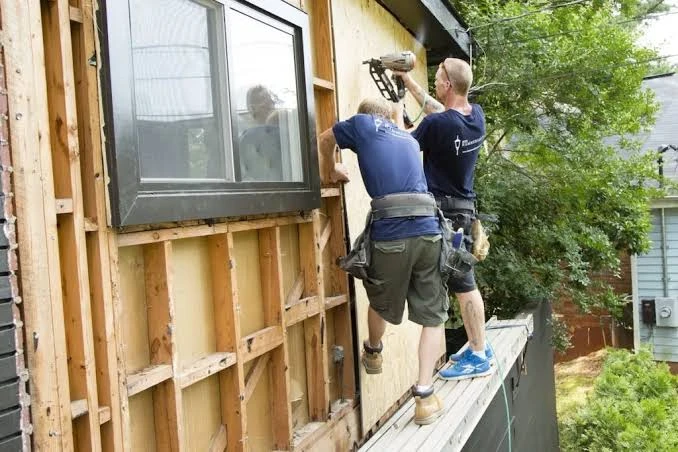


Siding to many is the most visible part of a house and least understood. Thus decisions made prior to the first panel going up determine whether or not a house designed to last twenty years or more will in fact last twenty years or more. Conversely, decisions made prior to the first panel going up will determine whether or not a repair to a house designed to last twenty years or more will in fact last twenty years or more. Thus, what follows is a framework for setting up a project for a cladding system and not a surface.
Understand what the wall behind the cladding is actually doing
Water enters a house through various cracks and crevices in a building’s envelope. Siding is designed to slow water down so that the weather resistive barrier, flashing, and water management behind the siding can contain water to protect structural parts of a building.
Before selecting the exterior finish, include an inspection of the sheathing in the scope of work for the tear-off. Most of the time there is significant rot around window sills, band joists and below the roof-to-wall intersection. This is caused by poor or missing flashing rather than poor exterior finish.
Details worth confirming in writing
-
How the housewrap is lapped, and whether it is integrated with window flashing tape or simply run past it
-
Whether a rainscreen gap or furring strips are included, particularly for absorptive materials such as wood or fiber cement
-
Kickout flashing at every point where a roof edge meets a vertical wall
-
Clearance between the bottom course and grade, hardscape, or roofing
-
Treatment of penetrations for hose bibs, dryer vents, and electrical service
Match the material to climate exposure, not just appearance
These decisions can and should be made before viewing a house with siding. Often a homeowner will want to pick siding for a house based on viewing a picture of a house with siding. There are many other decisions to make in choosing siding for a house such as amount of exposure, amount of maintenance a homeowner is willing to do, how long a homeowner plans on keeping a house.
Where regional conditions change the math
Finally, the fasteners and finish of the siding will deteriorate due to high humidity, freeze-thaw cycles and salt spray. For that reason, homeowners near the water are well advised to work with a specialist in siding installation Annapolis MD who will specify stainless steel or hot-dipped galvanized fasteners for exterior surfaces of the house, such as for siding on walls below grade or for siding on exterior of walls of porches and covered areas. What type of fasteners will your contractor be using for the siding on your house and why?
Evaluate the contractor on process, not on price per square foot
There can be a huge difference in price between three different bids for the same house. The difference is not necessarily in the cost of the siding but in what is included in the bid for tear-off, sheathing, flashing and trim/soffit.
Questions that separate a real proposal from an estimate
-
What is the unit price for replacing damaged sheathing, and how is the quantity verified before the work is billed?
-
Is the crew employed directly or subcontracted, and who supervises daily?
-
Which manufacturer certification does the installer hold, and does that certification affect warranty terms?
-
How are trim, corners, and window returns detailed, and are those shown in the scope?
-
What is the plan for containment and disposal if the existing material predates 1980 and may contain asbestos?
Plan the schedule around weather, not around convenience
Open walls = vulnerable walls. Remove the minimum amount of cladding to complete the work in the same day. Manage your crew size and create a detailed daily plan.
Colder weather affects the cure of caulk and the expansion of vinyl. Hot weather affects paint adhesion to site-finished materials. Instead of trying to fit in these extra days of work at the end of the schedule, they can be included in the buffer days for rain.
Set the maintenance expectation before the final payment
Most importantly, the workmanship warranty for the installer provided for the exterior cladding will generally be in effect for the 8-10 years after the material warranty expires for the siding. Read the fine print for exclusions from workmanship (e.g. Washing, painting, high pressure cleaning, etc.) as well as limits for pressure, etc.
A workable annual routine
It is not until long after the winter of a very wet year or in the midst of a very wet stormy year, that most homeowners finally go outside to inspect the exterior of their home. In most cases by the time the exterior of your home develops visible signs of damage or neglect, simple repairs can be made to correct any number of problems such as open caulk joints at the corners of windows and trim, staining below windows, loose or sagging siding and overgrown vegetation into walls. In most cases such problems can be repaired for a fraction of the cost to repair concealed moisture problems that have existed for three years or more.